Hello, world leaders.
This is our first devlog. We’ve been shipping updates for Global Protocol: New World Order since the Playtest opened in March, but we’ve never stepped back to show you what’s actually happening under the hood — or how far the game has come.
Version 0.5.0 just went live, and it brings the feature many of you have asked about since day one: multiplayer. That made this feel like the right moment. Multiplayer is the finishing touch of this story — but to explain why it was hard, and why we’re proud of it, we have to start with the world itself.
First, a quick introduction, since it’s something we get asked. I’m Ozan Kanık, founder and developer at Dorlion Interactive. I’ve worked as a professional software developer for more than 12 years and have shipped mobile games before. Most of this devlog is about the part of game development I’ve spent my career on: architecture, performance, and making complex systems behave.
Seven months, one planet
The first line of code went in during mid-February 2026. Within two weeks we had a rough map, an economy, diplomacy, AI, nuclear weapons and save/load all talking to each other. Everything since then has been about making those systems deeper, faster and truer to the real world.
- First commit. Map, economy, diplomacy, AI, nuclear weapons and saving roughed in within two weeks.
- Steam page and Playtest. Fog of war, DEFCON and battle fronts arrive.
- Envoys and specialists replace simple spy agents, and work on a resource-based economy begins.
- UN Security Council votes, full modding support and 12 languages — and, quietly, our first multiplayer prototype.
- Early Access launch. Linux, Steam Deck and macOS follow within weeks, along with Steam Workshop, Czech as our 13th language, the globe view, political parties and elections.
- Trading cards and 2,000 copies sold. Reconnaissance satellites, submarine-launched missiles, physical resource stockpiles and national laws.
- v0.3 — the Knowledge Network. 150 doctrines replace the old 56-node tech tree. The Mod Builder, spectator mode and legislative packages land.
- v0.4 and v0.5. A real-world commodity economy with physical trade, a Security Council veto, diplomatic trust and embassies, an air and naval overhaul, census-accurate populations — and multiplayer for everyone.
That pace was only possible because of you. Every bug report, every forum debate about balance and every puzzled “why did that AI just do that?” has shaped this list.
What “simulating everything” actually means
When you press play, Global Protocol isn’t just running your country. It’s running all of them.
Every in-game day, the simulation advances:
- 4,604 provinces and more than 6,300 sea zones, each with its own owner, population, buildings, terrain and supply.
- An economy of 54 goods — oil, lithium, wheat, steel, semiconductors, financial services — produced province by province, stockpiled, traded and priced on a world market.
- Up to 220 AI governments with budgets, debt, parliaments, parties, elections, laws, doctrines and long memories.
- Diplomacy built on trust, embassies, alliances, guarantees, sanctions, trade blocs and UN Security Council votes — vetoes included.
- Armies, fleets and air wings moving, fighting, blockading and supplying across the map, while envoys, cyber operations and satellites work in the shadows.
- And above it all, DEFCON: seven missile types, missile defence and the very real possibility of nuclear winter.
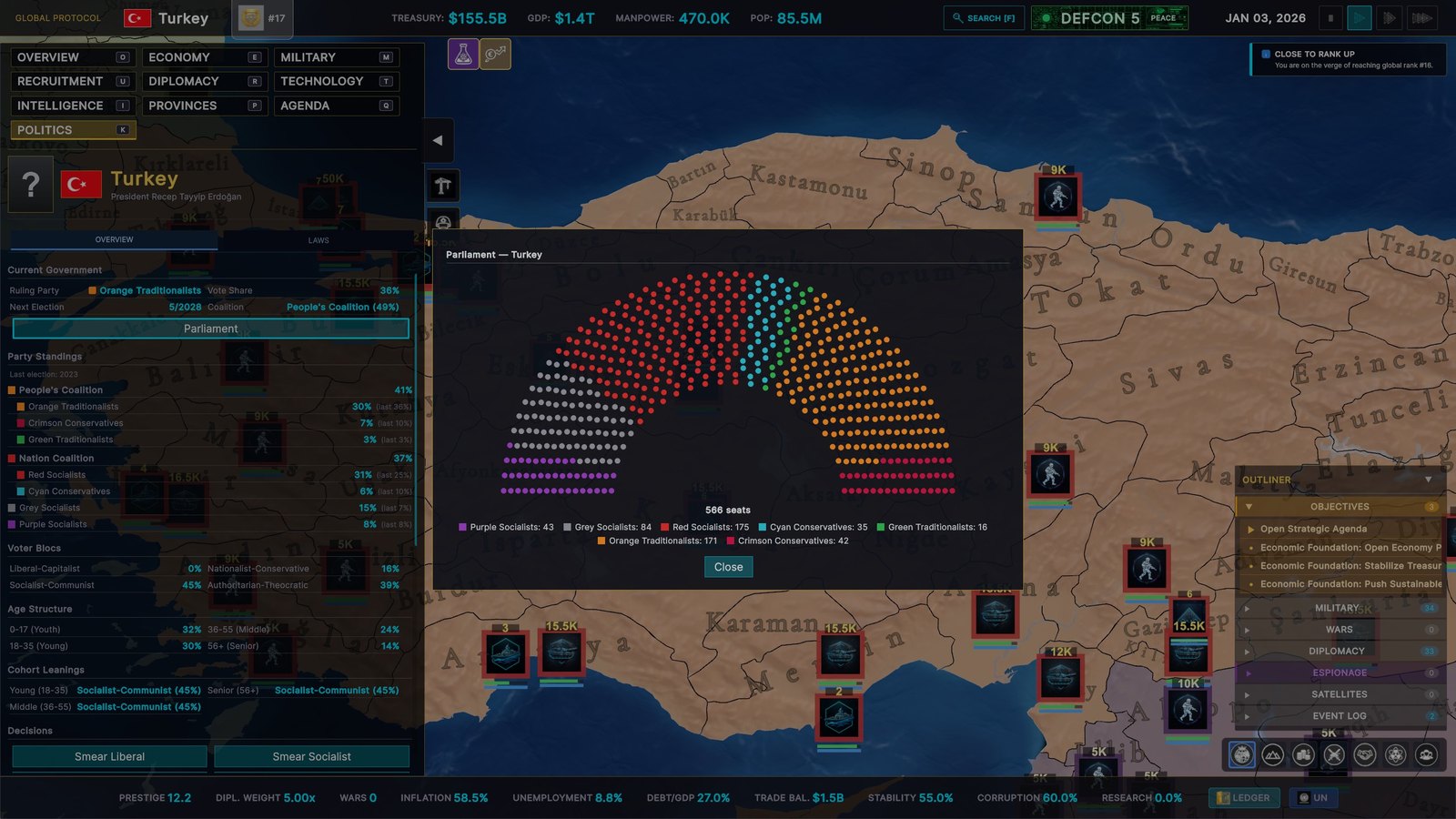
None of this starts from made-up numbers. The world of 2026 is assembled by a data pipeline that pulls from the World Bank, the IMF, USGS mineral surveys, the FAO, the Energy Institute, the EIA, OPEC, the World Steel Association, the IEA, Natural Earth, NOAA elevation data and national statistics offices. In v0.5.0 alone, we hand-curated the population of every province in all 221 countries against census figures.
Real numbers in, emergent history out. That’s the promise. The hard part is making it fast.
Why DOTS
Global Protocol is built on Unity DOTS, the Data-Oriented Technology Stack. If you’re not a programmer, here’s the short version.
A traditional game engine thinks in objects: a “France” object, a “Paris” object, each carrying its own bundle of data and logic, scattered around memory. That’s fine for a few hundred things. It struggles when thousands of provinces, hundreds of countries and more than a thousand armies all need updating every single day.
DOTS flips that around. Data lives in tightly packed arrays — every province’s population side by side, every army’s position side by side — and small, focused systems sweep through it in bulk. Processors love this: they read memory in straight lines instead of chasing pointers. The Burst compiler then turns our hottest code into highly optimised native instructions, and the job system spreads the work across your CPU cores.
Today the simulation is made of roughly 240 ECS systems with more than 800 Burst-compiled entry points. Each system does one job — grow populations, settle trade, resolve a battle, tally a vote — and they always run in the same fixed order. (That last part matters a lot later.)
What it buys us
A few numbers from our own profiling:
At normal speed a game day lasts two seconds, so the whole planet’s daily work fits into a tiny slice of it.
That headless mode is one of our favourite tools. We can let the world run for years with no graphics and no player, then compare the results between versions to catch economic drift, runaway wars or AI that behaves strangely. Because the simulation is deterministic, a headless run and a normal run produce the same world — down to the last digit of GDP.
How 220 AI governments think without melting your CPU
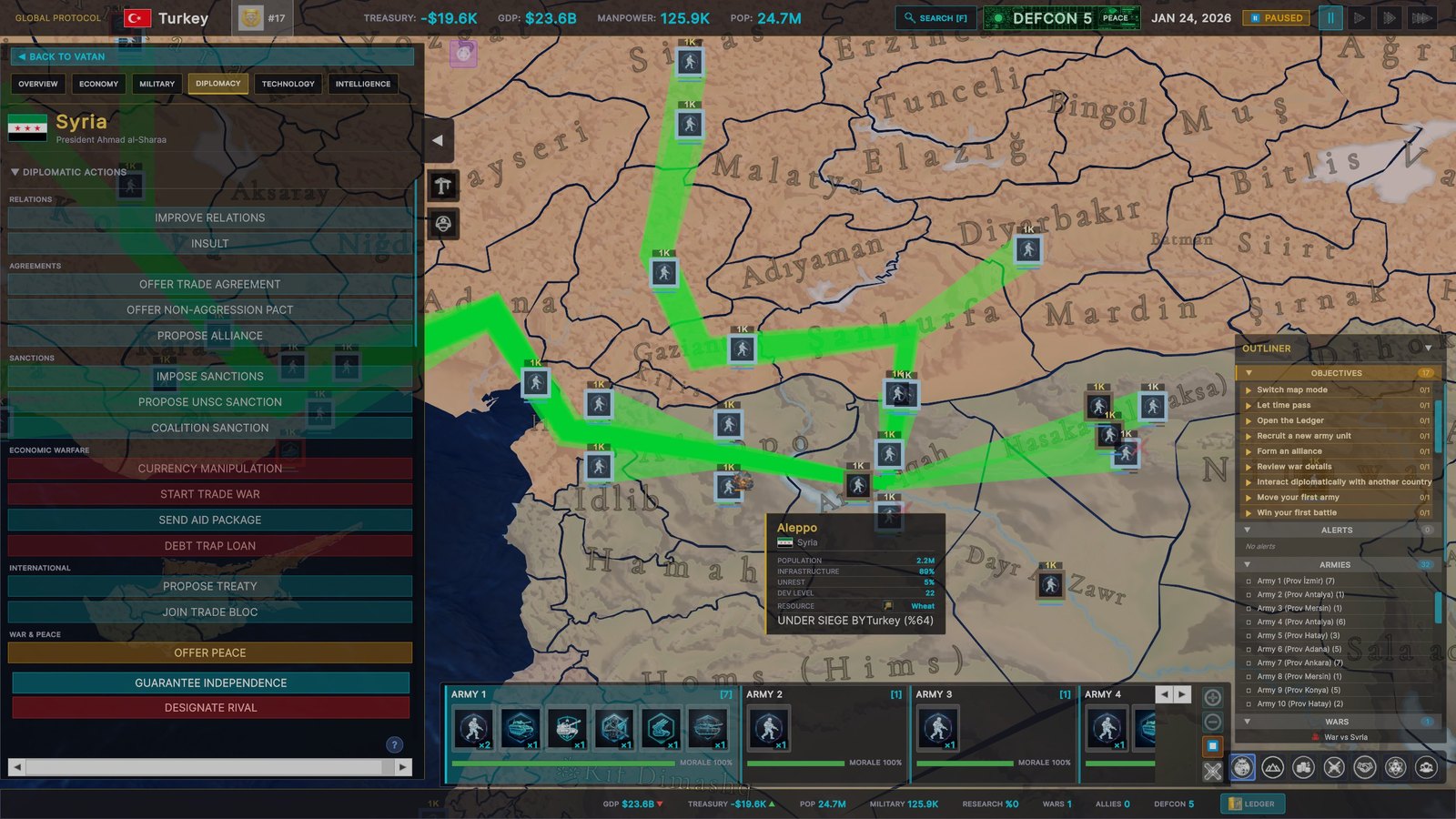
Every country you don’t control is run by an AI that weighs its options with utility scoring: each possible action — build a factory, sign a pact, raise taxes, declare war — gets a score from a set of weighted factors, shaped by that nation’s personality. The AI thinks on four levels: a grand strategy it revisits every year, strategic priorities every quarter, operational decisions every month, and tactical orders for each army.
If all 220 governments did their monthly thinking on the same day, you’d feel a hitch every month. So we don’t let them. Each country is assigned one of 30 planning days in the month, derived from its country code. On any given day only about nine governments sit down to plan, and the load stays flat instead of spiking.
Things DOTS taught us the hard way
Performance work is rarely a straight line. A few of our favourite lessons:
“Just Burst everything” was wrong. It sounds obvious: Burst makes code fast, so compile every system with it. When we measured, the Burst-compiled systems in the slice we profiled cost more in total than every managed system combined. The compiler wasn’t what separated fast from slow. What mattered was how much work a system did per tick, and whether many countries piled that work onto the same day. We fixed the work, not the label.
Our monthly clean-up ran every frame. A check like “is it a new month?” sounds harmless. But one game day spans many rendered frames, and for that whole day the check kept saying “yes”. In one profiling capture a monthly job ran around 180 times instead of six. One line of logic, a big pile of wasted time.
“Staggered” isn’t staggered if everyone starts at zero. Fog of war was meant to update countries on a rolling schedule. But every country started with the same “last updated” stamp, so all 220 AI countries went through the gate together — forever. Giving each country its own phase cut that system’s worst frame by nearly two-thirds.
Freeing memory doesn’t always free memory. In DOTS, creating a query and disposing of it still leaves a few kilobytes behind for the lifetime of the world. Do that every tick and a long campaign slowly bleeds memory — about 12 MB per in-game month in one 40-year soak test. Now every query is cached, and an automated test fails if anyone creates one inside a tick again.
How we keep a simulation honest
A world this interconnected breaks in surprising ways. A tax change in one country ripples into commodity prices on the other side of the planet; a border war shifts a trade bloc vote three months later. So we test relentlessly:
- More than 16,000 automated tests cover the simulation, from single formulas to full games.
- Headless soak runs simulate years of world history, so we can compare economies, wars and AI decisions between versions.
- The data pipeline validates every config before it reaches the game.
All of that turned out to be the foundation for something we’d been building towards since May.
The finishing touch: multiplayer
v0.5.0 brings online multiplayer to everyone. Up to eight players share one world, each leading a nation, while the AI runs every other country on Earth.
Here’s the problem. In a shooter, a server sends everyone the positions of a few dozen players. In Global Protocol, “the state of the game” is the planet: thousands of provinces, dozens of goods in every market, hundreds of governments, and all their armies, fleets, treaties and elections. Streaming that across the internet would be like emailing an encyclopedia every two seconds.
So we don’t send the world. We send orders.
Lockstep: every machine runs the whole planet
Multiplayer uses a model called deterministic lockstep. When you build a factory, move an army or propose a treaty, only that order — one of 76 command types — travels to the other players. Every machine then applies the same orders, on the same day, in the same sequence, and simulates the entire world by itself.
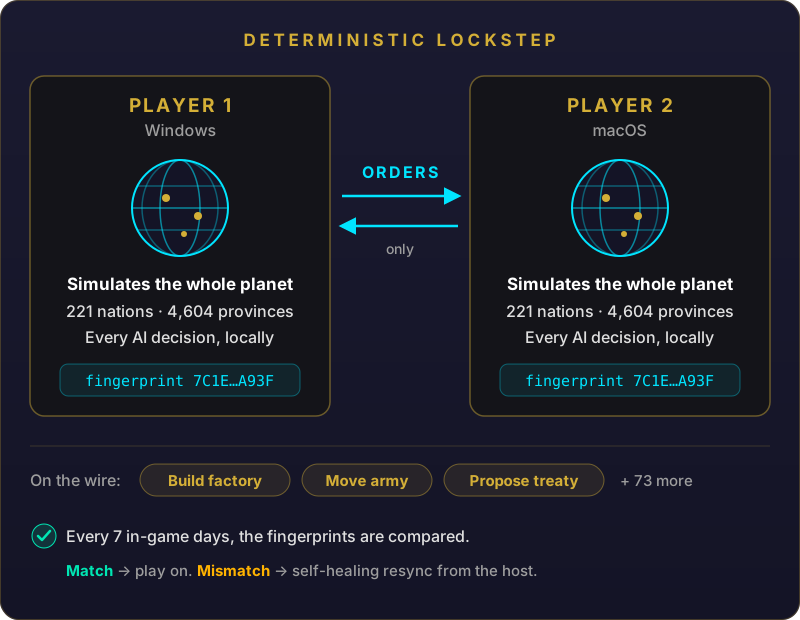
That includes the AI. More than 200 AI governments make their decisions independently on every player’s machine, and they have to reach exactly the same conclusions. No AI decision is ever sent over the network: each machine thinks the same thought at the same moment.
That’s why determinism was built into the foundation long before multiplayer existed: a fixed system order, randomness seeded from stable identities (a country’s code, a province’s ID, the date) instead of anything that differs between machines, and sorted iteration wherever order could matter.
Remember those AI planning days? Early on, a country’s day was derived from where it happened to sit in memory. That position isn’t guaranteed to match on two machines, so the same country could do its monthly thinking on different days on each one. Today the day comes from the country’s ISO code. A small detail — but lockstep lives and dies on small details.
The proof
In our final multiplayer sessions before release:
We also ran a session between a Windows PC and a Mac and compared 1,476 AI utility calculations one by one. Every one matched, bit for bit.
Detection and recovery, built in
Determinism is the goal; verification is the guarantee. Global Protocol doesn’t hope every machine agrees. It checks.
- A fingerprint every game week. Every seven in-game days, each machine computes a 64-bit fingerprint of the world — game state, provinces, countries, armies, diplomacy and politics — and compares it with everyone else’s. Each of those six sections is fingerprinted separately, so if anything ever drifts we know exactly which part of the world it was.
- Self-healing resync. If fingerprints ever disagree, the host automatically captures a snapshot of the world and streams it to the other players, paced to their connection. The host then reloads that exact snapshot itself, so every machine continues from byte-identical state. You see a short sync screen, and play goes on.
- Mismatches refused at the door. Before a session starts, the lobby checks everyone’s game version, mod set and scenario. If they differ, you find out up front — not an hour into a campaign.
- Guard rails in the codebase. Automated tests scan our source for anything that could behave differently on two machines — unseeded randomness, timers, unordered iteration — and fail if they find it. Mods that use non-deterministic randomness are blocked from multiplayer.
Everything you do in single player — now with friends
Multiplayer isn’t a cut-down mode. Everything you can do in single player, you can do in multiplayer. Run your economy and budget, trade on the world market, research the Knowledge Network, pass laws and win elections, send envoys and run covert operations, negotiate treaties, impose sanctions, vote in the Security Council, command armies, fleets and air wings — and, if it comes to it, climb the DEFCON ladder. Build an alliance with your friends against the rest of the world, race them for economic supremacy, or turn on them when the moment is right. Mods and custom scenarios work too, as long as everyone runs the same set.
And the session itself is built to be painless:
- Host or join from the main menu, and invite friends straight from the Steam overlay.
- Pick your nation on the map. Two to eight players, each leading a different country; the AI runs the rest of the world.
- The host sets the rules: difficulty, AI aggressiveness, lobby privacy and game speed.
- Know who’s who. Nations led by players are marked on the map, and pressing Tab shows every player’s nation, ping and connection.
- Chat in the lobby and in game.
- Drop-outs are handled. If a player disconnects, the game pauses; the host can wait or carry on with the AI taking over, and the player can rejoin to take their nation back.
- Resume campaigns. Multiplayer games save, and you can pick them up later from the lobby. If the host leaves, the session ends for everyone — just reload it from the lobby’s campaign list.
- Cross-play between Windows, macOS and Linux.
What’s next
v0.5.0 is a milestone, not a finish line. We’re still in Early Access, and your feedback decides what comes next. Our development roadmap is public: you can see what we’re working on and what’s coming on our roadmap page.
Thank you
Seven months ago this was an empty project and a map of the world. Today it’s 221 nations, a living economy, two hundred AI governments arguing at the UN — and now, a world you can share with your friends.
Thank you for playing, for reporting bugs, for arguing about balance, and for sticking with us. If you’d like to help a small team, a Steam review makes a real difference.
See you on the world stage. Bring a friend.
— Ozan Kanık, founder, Dorlion Interactive